
Canine Achilles Tendon Rupture
 The canine Achilles tendon is really a group of five tendons located at the back of the dog's hind legs. These tendons are important to the animal's mobility because they assist in bending and moving the hind knees, flexing the hind ankles, and moving the toes and upper legs. The rupture or tear of a dog's Achilles tendon is a serious injury but usually has a good prognosis.
Causes of Achilles Tendon Rupture
Typically, the rupture of the Achilles tendon occurs because of an injury, most commonly a fall, although a puncture wound may also cause the tear. While the tendon rupture may occur because of sudden trauma, it is also possible for the tendon to lacerate over a period of time.
Risk Factors for Achilles Tendon Rupture
While any dog may suffer an Achilles tendon rupture, this injury is more common in:
- Large breeds
- Working dogs
- Very active dogs
- Dogs over the age of 5
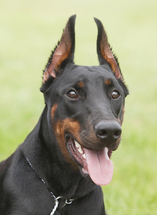
Doberman Pinschers are especially susceptible to this condition.
Symptoms of Achilles Tendon Rupture
The rupture of a dog's Achilles tendon may be partial, affecting only some of the tendons involved, or complete, in which case all five tendons are torn. In either case, the animal will experience pain and inflammation at the site. An Achilles tendon rupture may leave the dog temporarily lame, able to walk, but in an awkward crouched position, standing on tiptoe with the affected limb, or walking with the ankles on the ground, rather than just the paws.
Diagnosis of Achilles Tendon Rupture
In order to diagnose a canine Achilles tendon rupture, the veterinarian will need to perform a physical examination. X-rays and ultrasound may also help in assessing the extent of the injury.
Treatment of Achilles Tendon Rupture
In mild cases of this injury, where the tear is partial, it is possible that the veterinarian will simply splint the affected limb and that the dog will heal without surgery. In the majority of cases, however, the damaged tendon will require surgical repair.
For many dogs and their owners, the most difficult part of an Achilles tendon rupture may be keeping the animal relatively inactive before and after surgery. After surgery, the dog will be in a cast for about 2 months and may be required to wear a supportive bandage for a couple of additional weeks.
If the rupture of an Achilles tendon is suspected, it should be examined and treated as quickly as possible. The surgical repair will be easier, and is likely to be more effective, if the injury is treated promptly. Once scar tissue forms, it will be more difficult to perform the surgical repair.